

Focus Keyword: HDMI/ambient TV backlight sync
Introduction
The boom in HDMI/ambient TV backlight sync products is transforming living rooms worldwide, making immersive movie nights and gaming setups more accessible than ever. But rapid growth sparks questions: Does the tech work as advertised? What problems do real buyers face? This guide dives into the core facts, practical steps, and realistic pitfalls so you can confidently plan your own upgrade.
Key Takeaways
- The HDMI/ambient TV backlight sync market is seeing double-digit growth and rapid innovation, but installation and compatibility issues remain common user headaches.
- Premium HDMI-sync kits offer superior color accuracy and low latency but can be expensive, especially when factoring in hidden costs such as cables or power supplies.
- Dynamic color lighting boosts ambience—however, the best setup for eye comfort is still a static, neutral white bias light behind the screen.
Table of Contents
The Core Concept
HDMI/ambient TV backlight sync creates a vibrant, color-matching glow behind your television by analyzing HDMI video content in real time. This hands-off technology is built to amplify immersion, boost mood, and—when set correctly—even reduce eye strain by balancing screen-to-room contrast. The tech is surging: industry sources put the 2024 ambient sync box market between $486.7M and $1.2B, targeting everything from blockbuster movies to marathon gaming, with HDMI-based solutions holding nearly half the market share [source].

What makes HDMI/ambient TV backlight sync unique is its ability to synchronize lighting with every on-screen moment—using HDMI data (not a laggy camera). With features like 4K pass-through, multiple device support, RGBIC lighting, and smart home integration, setups now range from affordable plug-and-play kits to premium systems such as Philips Hue or Govee.
Why does it matter? Search trends and sales data (especially in Q4 2024) show users crave immersive home entertainment—and are willing to pay for low-latency, reliable sync. But, as discussed below, effective setup requires understanding the balance between dynamic lighting, technical limitations, and proven eye comfort strategies. For more on TV LED light trends, see our in-depth buyer guide.
Step-by-Step Guide
Before diving in, make sure you’re clear on installation size, content needs, device compatibility, and room setup. This process focuses on a typical mid-to-premium HDMI sync kit:
-
Unbox and Test Components
Check the integrity of strips, sync box, remote, and power supplies.
Check before sticking or wiring – defective LEDs are easier to replace now than after install. -
Plan LED Placement
Dry-fit the LED strips on the back of your TV. Most kits cover 55–65″, but for larger screens, confirm you have manufacturer-approved extensions.
Read our smart LED strip installation hacks. -
Mount LED Strips
Clean the mounting surface thoroughly—adhesion failures are a common customer complaint. Start with the top and sides; if using corner connectors or channels, test fit first.
Avoid stretching the strip; instead, gently press using a microfiber cloth for consistent contact. -
Connect HDMI Inputs and Sync Box
Follow the kit’s wiring diagram. Plug your streaming box, console, or Blu-ray player into one of the sync box’s HDMI inputs.
For compatibility, ensure all cables meet at least the HDMI spec required for your devices.
Find step-by-step guides for cable management and channel mounting. -
Power Up and App Setup
Link the system to your Wi-Fi or Bluetooth (if supported), then run the app’s guided calibration.
Align color zones if prompted—this is essential for accurate screen-to-wall color matching. -
Integrate with Smart Home (Optional)
Connect your kit to Alexa, Google, or Matter via app or hub (as supported). Set up scenes and test voice commands for routine use. -
Fine-Tune Modes and Brightness
For eye comfort, set a static neutral white for bias-lighting sessions—ideally at ~10% TV peak brightness. For immersion, enable dynamic color modes.
Learn about tuning LED color temperature for the ideal setting.
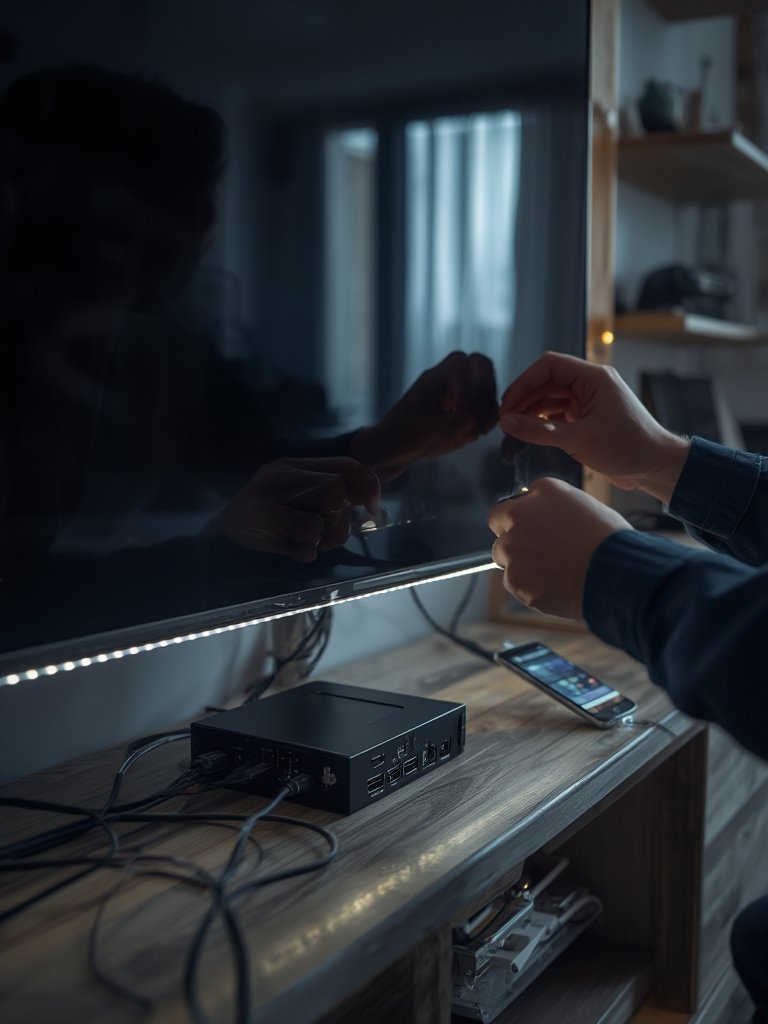
Want to see how lighting impacts eye comfort? Check our guide to Matter-enabled bulbs vs. proprietary systems and understand how you can benefit from open smart-lighting setups.
When finished, stand back in low room light and test your setup with a high-contrast scene. Tweak app settings as needed. If edge alignment seems off or color sync lags, consult your product’s troubleshooting manual—or explore more problem-solving tips in our HDMI sync lighting troubleshooting section.
Advanced Analysis & Common Pitfalls
While HDMI/ambient TV backlight sync kits promise plug-and-play magic, real-world research and verified reviews reveal some common issues:
1. Installation Headaches
- Adhesion fails: Strips and diffusers may detach, especially if the TV isn’t cleaned rigorously. Large, curved, or textured TVs are the toughest to mount.
- Instruction confusion: Many users find manuals lacking or misleading, leading to misplaced segments or app setup errors.
- Cable clutter: With 2–4 HDMI sources, extra power supplies, and wires, TV backs get messy—so cable channels or spiral wraps make a big difference.
2. HDMI Pass-Through and Compatibility Issues
- Next-gen gaming bottlenecks: Not every kit supports 4K@120Hz or VRR. Some “4K HDR” labels only mean 4K@60, causing headaches for PS5/Xbox users.
- Streaming app blind spots: Many sync boxes can’t see video from built-in TV streaming apps (Netflix, etc.) since the HDMI box only sees external source signals. Use an external streamer for full sync.
- ARC/eARC handshakes: If you use a soundbar and sync box, misconfigured HDMI chains can cause audio dropouts or black screens.
- Smart-home hiccups: Some systems lack robust support for Alexa, Google Home, or Matter, so automating lighting scenes may be unreliable.
3. Performance Variability
- Color lag or inaccuracy: Budget kits, and most camera-based systems, cannot match premium HDMI-sync solutions for color accuracy or low latency. One top study found ~23% better color matching with HDMI sync [source].
- Brightness mismatch: On large TVs (75″+), underpowered kits look patchy or too dim. Wall color and seating distance dramatically affect subjective experience.
- Eye comfort vs. ambience: Dynamic lighting is fun—but for real eye comfort, use static D65 (6500K) white. Failing to adjust can actually increase fatigue (see our scientific breakdown in this analysis of bias lighting).
| Feature | BASIC/CAMERA SYSTEMS | HDMI 2.0b | HDMI 2.1 (New Gen) |
|---|---|---|---|
| Max Resolution | Up to 1080p | 4K@60Hz | 4K@120Hz, 8K@60Hz |
| Latency | High (0.3-1s typical) | Low (~50ms) | Ultra-low (<30ms) |
| Color Matching Accuracy | Poor/Moderate | Good | Excellent |
| Number of HDMI Inputs | – | 1-2 | 2-4 |
| HDR/VRR/ALLM Support | No | Partial/Basic | Full (in premium models) |
| Smart Home Integration | Rare | Moderate (some Alexa/Google) | Wider (Alexa, Google, Matter) |
| Best For | Cheap mood, small TVs | Streaming, casual gaming | Premium gaming, big screens |
Cost is another pitfall: entry kits start around $80 but quickly rise to $250–$350+ for premium multi-input HDMI sync boxes, especially if you need extra strips or hubs. And don’t forget hidden expenses—certified high-speed HDMI cables, mounting channels, and occasional pro installation can add $40–$150.
For more on cost-effective alternatives, compare popular standalone light strips like the Philips Hue Indoor Smart RGBWW LED light strip for accent use, or browse LED ambience setups for bedrooms.
Finally, remember that the perfect setup is only as good as its calibration. Use tunable white for reference movie viewing, and regularly update firmware for new features (especially as AI-powered syncing and Matter compatibility expand in 2025–2026).

Conclusion
HDMI/ambient TV backlight sync is an exciting, fast-evolving way to transform your living room for movies, gaming, and mood lighting—if you choose the right kit and plan install carefully. While premium HDMI sync boxes now deliver real-time color matching, high-resolution pass-through, and smart home integration, be ready for the cost and take your time with installation to avoid pitfalls around adhesion, cable mess, or compatibility.
Remember: For the greatest benefit to eye comfort, set your kit to static neutral white as a bias light during long viewing sessions. Ready to take the next step? Research your TV and devices, compare kits—then turn your entertainment space into a true home theater with the right HDMI/ambient TV backlight sync solution.
Want more on lighting for modern homes? Check our guides on smart LED strip lights, modern living room ambience, and our deep dive into bias lighting and HDMI sync for healthy eyes.
FAQ
Do HDMI sync backlight kits work with built-in TV streaming apps?
Usually not. Most HDMI sync boxes only sync to video signals passed through their HDMI input. If you use Netflix or other apps on your TV directly, the backlight won’t react—unless your TV supports app-based syncing or you use an external streaming device.
Can HDMI sync boxes support 4K at 120Hz for gaming?
Only newer HDMI 2.1-capable boxes can reliably support full 4K@120Hz and gaming features like VRR. Many mid-range kits are limited to 4K@60Hz, so always check specifications if you have a PS5, Xbox Series X, or high-end PC.
What’s the best setup for reducing eye strain?
A static, neutral white bias light (around 6500K/D65), placed behind your TV at a modest brightness (about 10% of your TV’s peak output), is shown by research to reduce visual fatigue—dynamic color-changing lights don’t offer the same benefit for comfort.
How should I mount LED strips for the best adhesion?
Thoroughly clean your TV’s back panel with isopropyl alcohol before sticking strips, press them gently but firmly, and use cable channels or corner connectors for neat routing. Avoid mounting over vents or textured surfaces.
What hidden costs should I plan for?
Aside from the core kit, budget for extra or longer LED strips ($20–$60), high-speed HDMI cables ($10–$40), mounting or cable management hardware ($10–$40), and, for some brands, a required hub or bridge ($50–$60).